Supports
This information is designed to help you find, access, understand and navigate the various commonwealth, state and local choices and options in services and supports.


People with disability often need more support to maintain their quality of life and obtain vital services. People with intellectual and other developmental disabilities can sometimes have more difficulty in finding services and resources to support them in their daily life and future planning.


Information and help to get the right supports
Here at DDWA, it is our mission to provide information to help people with developmental disability get the supports and services they need. This could be
- information across life stages and focus areas like starting and finishing school, health care, finding a job, turning 16 or understanding and supporting communication and behaviour
- support to have your voice heard
- support to advocate for yourself or your family member to have your rights upheld
- support to communicate your needs to others
Currently, DDWA are not funded to provide individual advocacy, however, our experienced and friendly team can direct you to information and services who can work with you and/or your family on issues of concern.
DDWA Services


Information, Guidance and Support
We provide information to people with disability, family members, carers and supporters, across Life Transition Stages to help you to Self-Advocate and Navigate Systems including:
- getting a diagnosis
- navigating disability services and the NDIS
- starting school and negotiating the school journey
- making friends
- turning 18
- getting a job
- staying safe and healthy
- starting a relationship
We also provide information and guidance to support you to self-advocate in any area where laws have an impact on the person with disability's life, such as information about State Administrative Tribunal (SAT) in respect to Guardianship and Administration matters, Child Protection, Enduring Power of Attorney, Advanced Health Directives and preparing for illness/death of a parent.
For a full list of the areas we cover, see our Focus Areas Page Here.
Cost – This is a free service.

Side by Side Peer Community
Side by Side began as a project in 2012 for families experiencing behaviour which could be seen as challenging. The project connects families experiencing challenging behaviour with other families though a supported peer group, an active online community and in person events. Side by Side is a safe place to receive support and help each other.
For information and how to join, contact:
Bronwyn Pike: bronwyn.pike@ddwa.org.au, or
Maggie Visser: maggie.visser@ddwa.org.au
Website: ddwa.org.au/services/family-peer-support-side-by-side
Independent Support Coordination
DDWA are a registered NDIS provider for support coordination.
We can support you to fully understand and implement the funded supports and services in your NDIS plan.
This service is currently at FULL CAPACITY.
Resources

Autism Parents' Handbook 2025 e-Update

There's no such thing as a silly question

Approaching Adulthood

Walking Along Side Me
FAQ's

July 2026 Update: Self managing an NDIS plan
NDIS Check-ins. What are they and how to respond.

Understanding Guardianship and Administration: what you need to know when your child is approaching 18.

A Service for One

How can families provide training to support workers?
What do I need to know about self managing my NDIS plan?

How do I find support workers?
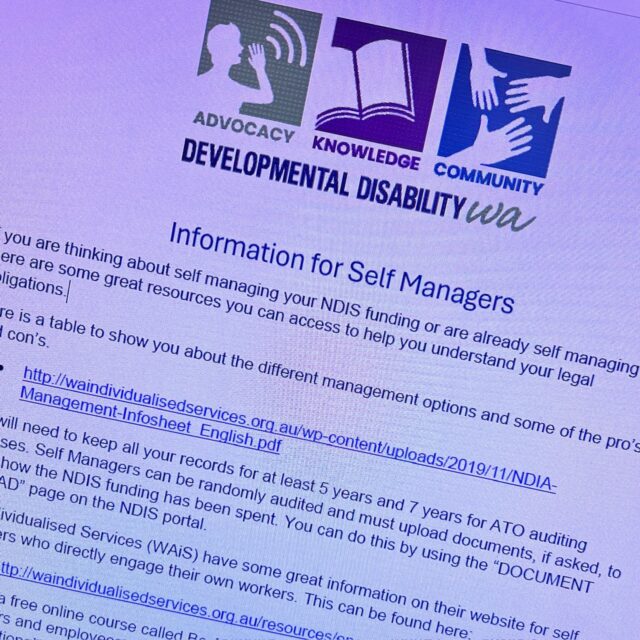
Information for Self Managers

How do I get support workers funded in my NDIS plan?

Do I need a Carer Statement for a NDIS Application or Review?
Peer Support Groups
Side by Side
Valued Lives
Valued Lives is a peer-led community organisation enabling vulnerable people to live valued lives in local communities. Valued Lives Peer-to-Peer Networks are a great place for people and families to come together to share information, knowledge and experience with their peers around all things NDIS/WA NDIS/Department of Communities (formerly DSC). Networks are facilitated by families and meet regularly in the local community.
Kristie Hardbottle: kristie@valuedlives.org.au
Website: valuedlives.org.au/peer-support
Alike WA (formally Connect Groups)
Alike WA is the peak body organisation advocating for peer support groups across Western Australia. They work to empower, represent, and support a vibrant network of peer-led groups throughout the State, fostering healthy, connected communities.
Kiind
Formally Kalparrin, Kiind operates Western Australia’s largest, member-only, online Peer Support Network. Connect with others in a private and non-judgemental space to share knowledge and experiences, ask questions, seek advice and build resilience as a parent of a child with additional needs. Kiind is not an NDIS provider and all services provided remain free-of charge.
kalparrin.org.au/services/peer-support
Carer Gateway
Care Gateway is a new Australia-wide network of Carer Gateway service providers. They offer membership to an online forum of carers who offer support to each other and share their stories.
Carers WA
Carers WA provide Linking Together Social Support groups for its members to take a short break from their caring role and to meet others in their local community. Groups run monthly throughout the metropolitan area and some regional areas. They are coordinated by trained and experienced volunteers.
More Information and Resources
Commonwealth Government
Services Australia
This link will connect you to Services Australia. Which delivers payments and services to Australians through Centrelink. People who receive support from Centrelink come from many different back-grounds and the benefits people receive reflect this. There are payments for people with disabilities, for older people, people who live in rural or re-mote communities, indigenous Australians, those affected by a natural disaster such as bush fire, families, job seekers and students
Website: www.servicesaustralia.gov.au
National Disability Insurance Scheme
This link will take you through to the website of the National Disability Insurance Scheme. The NDIS is Australia’s first national scheme for people with disability. It provides funding for Therapy, equipment and individual support services directly to individuals.
Website: www.ndis.gov.au
NDIS Where do I start?
Maggie from DDWA talks about the National Disability Insurance Scheme (NDIS) and how to get ready for a planning meeting and understand the funding sections of a NDIS plan.
Western Australian Government
Concessions WA
This is an easy-to-use online resource where you can search by category, concession card type or people group to find details on more than 100 rebates, concessions and subsidy schemes provided by the Government of Western Australia including discounts on dental care, glasses, transport and more.
This link will take you to this page to search for savings that suit your own circumstances:
Website: www.concessions.communities.wa.gov.au
ACROD Parking
ACROD parking allows people with a disability to park in dedicated bays. ACROD parking permits are free, funded by the Government of Western Australia.
Phone: 08 9242 5544
Website: www.acrod.org.au
Companion Card
If you have a disability and a lifelong need for ‘attendant need support’ to participate in community events and attend venues, this card can help with costs of getting out and about with the support of a companion. The card is issued in your name and is valid for 5 years. It gives you as a cardholder freedom to go to different places with different people. Your companion may be a partner, family member, friend, volunteer or paid care assistant/support worker.
Present your card when purchasing tickets at participating businesses or transport and you are issued with a second ticket for your companion at no charge. It is recognised throughout Australia.
Phone: 1800 617 337
Email: wa@companioncard.org.au
Website: www.wacompanioncard.org.au
Department of Communities
Disability Services has web page with links to many recreation options as well as the locations of “Changing places” which are venues in the community with facilities which include hoists and changing facilities for adults.
Apply to get an Access Key (Master Locksmiths Access Key (MLAK)) for Changing Paces facilities here:
https://masterlocksmiths.com.au/event-6048336
Information for Self Managers
Thinking about self managing your NDIS - or already a Self Manager?
DDWA have developed this handy PDF with some great resources you can access to help you understand your legal obligations.