
Advocacy
Advocacy means promoting, protecting and supporting the full and equal human rights of people, often described as “standing up for yourself and others”.


People with intellectual and other developmental disabilities have human rights that are sometimes not recognised or upheld. They may want or need a trusted person to help them speak out and defend their rights or at times advocate on their behalf. The advocate may be a family member, carer, friend or they may be a professional advocate who is paid to advocate for others.
There are six main types of advocacy:
- Self advocacy – people stand up for themselves or are supported to do so
- Family advocacy – families stand up for themselves or are supported to do
- Citizen advocacy – a member of the community is matched with a person on a voluntary basis to provide ongoing one to one advocacy
- Individual advocacy – an advocate supports an individual or family to stand up for their rights and needs
- Legal advocacy – an advocate represents and defends the legal rights of another and has legal qualifications
- Systemic advocacy – an individual or group seeks to lobby for reform and change of social systems and structures that discriminate against, abuse or neglect the rights of others
DDWA Services


Information, Guidance and Support
We provide information to people with disability, family members, carers and supporters, across Life Transition Stages to help you to Self-Advocate and Navigate Systems including:
- getting a diagnosis
- navigating disability services and the NDIS
- starting school and negotiating the school journey
- making friends
- turning 18
- getting a job
- staying safe and healthy
- starting a relationship
We also provide information and guidance to support you to self-advocate in any area where laws have an impact on the person with disability's life, such as information about State Administrative Tribunal (SAT) in respect to Guardianship and Administration matters, Child Protection, Enduring Power of Attorney, Advanced Health Directives and preparing for illness/death of a parent.
For a full list of the areas we cover, see our Focus Areas Page Here.
Cost – This is a free service.

Side by Side Peer Community
Side by Side began as a project in 2012 for families experiencing behaviour which could be seen as challenging. The project connects families experiencing challenging behaviour with other families though a supported peer group, an active online community and in person events. Side by Side is a safe place to receive support and help each other.
For information and how to join, contact:
Bronwyn Pike: bronwyn.pike@ddwa.org.au, or
Maggie Visser: maggie.visser@ddwa.org.au
Website: ddwa.org.au/services/family-peer-support-side-by-side
Independent Support Coordination
DDWA are a registered NDIS provider for support coordination.
We can support you to fully understand and implement the funded supports and services in your NDIS plan.
This service is currently at FULL CAPACITY.
DDWA Resources

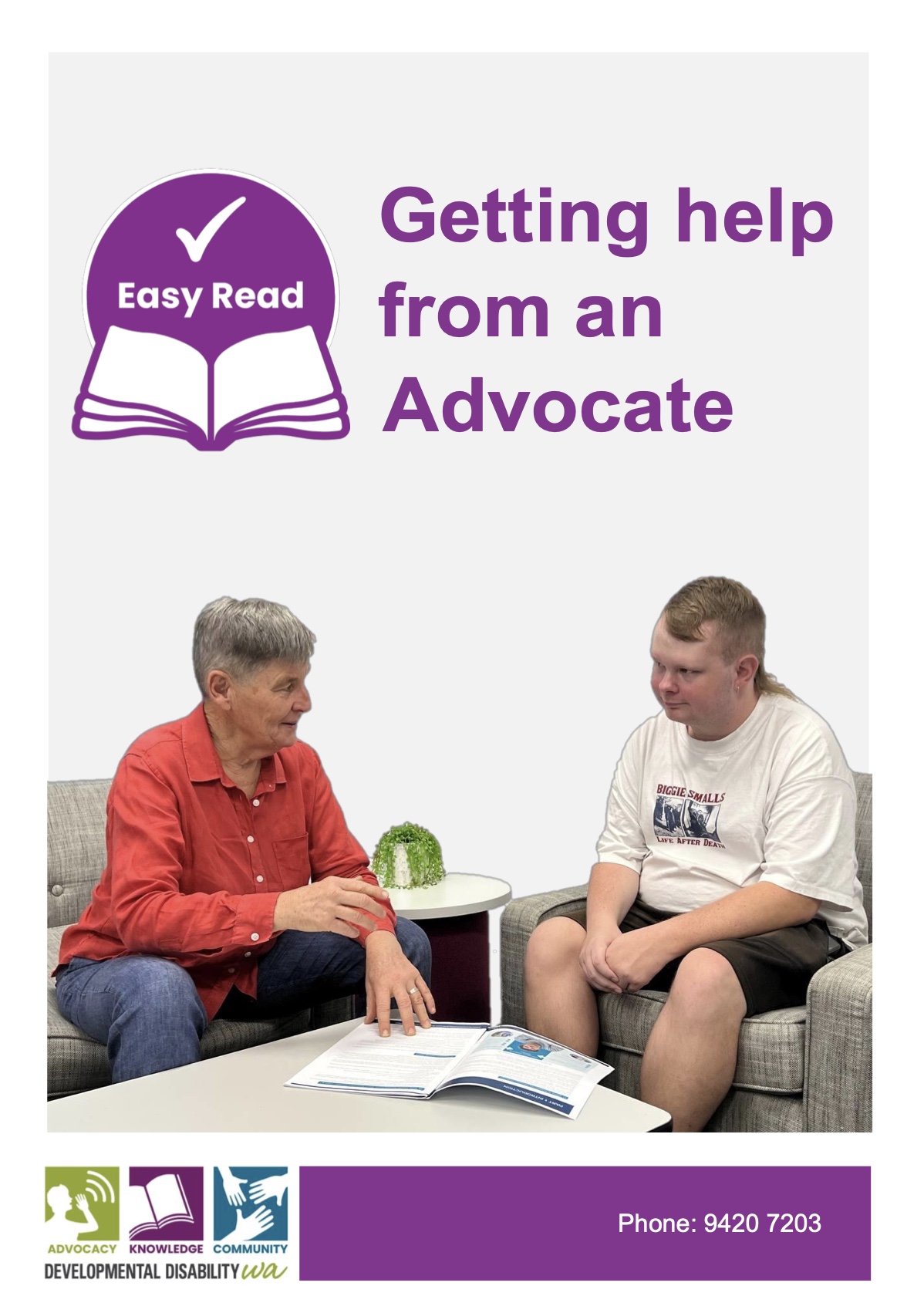
Getting Help From An Advocate

Standing Up For Someone You Love
Self Advocacy

Supporting people with intellectual disability to know and exercise their rights.
Beginning in 2021, DDWA has received NDIS ILC funding to offer a Self Advocacy Program for people with intellectual disability in schools and community group homes.
We would like to share the resources we use in our workshops to support more people to have access to build their self-advocacy skills.
Our Self Advocacy Program resources including a PowerPoint presentation and a workbook are now available for you to download for FREE.
Click here to go to the resources: https://ddwa.org.au/our-projects/self-advocacy-program/
If you would like more information about this program or how to use the resources, please contact Theresa or call DDWA on 9420 7203
Listen in on this podcast with DDWA's Maxine Drake speaking with Blooming Supports - "Beyond Labels" about advocacy and how DDWA helps people and families to stand up for their rights and needs. In Max's words; "this is is something you need to be aware of as being out there in the world." An amazing conversation that could help many.
Click here to listen: https://buff.ly/4dLQBFB
(or click on image of podcast episode)
FAQ's

Self-Advocacy Guide for Parents and Carers in the WA Education System

Advocacy in Schools
Further Information
Disability Advocacy Support Helpline - A guide to our services (dss.gov.au)
- The Helpline is a short-term, individual advocacy service for all people with disability, their carers or support people. The service is provided over the telephone.
- You can find the Helpline through the Disability Gateway: 1800 643 787
- Email: thehelpline@advocacylaw.org.au
Disability advocacy for individuals fact sheet (from Australian Government Department of Social Services)
Easy to Understand Resources

Click on the link to go to our Easy Read page where you can find accessible resources and information on Advocacy and many other topics.
